


National Panchayat Awards 2025
Syllabus: GS2/ Polity and Governance
Context
- The Ministry of Panchayati Raj has announced the winners of the National Panchayat Awards (NPA) 2025, with 42 Panchayats from across India.
National Panchayat Awards
- About: The National Panchayat Awards are administered by the Ministry of Panchayati Raj to recognize and incentivize high-performing Panchayats.
- Objective: The National Panchayat Awards drive competitive federalism by incentivizing local self-government institutions to compete in achieving the good governance & Sustainable Development Goals (SDGs).
- Implementation Framework: The awards are conferred under the Incentivization of Panchayats (IoP) scheme, a component of the Rashtriya Gram Swaraj Abhiyan (RGSA).
- Financial Incentives: Winning Panchayats receive financial incentives ranging from ₹50 lakh to ₹5 crore, depending on the category and tier.
- Karnataka secured the highest number of awards (6 awards), followed by Andhra Pradesh and Odisha with 5 awards each for 2025.
Categories of Awards
- Deen Dayal Upadhyay Panchayat Satat Vikas Puraskar (DDUPSVP): Recognizes outstanding Gram Panchayats based on performance across the nine themes of Localization of Sustainable Development Goals (LSDGs).
- Nanaji Deshmukh Sarvottam Panchayat Satat Vikas Puraskar (NDSPSVP): Conferred on the best-performing Panchayats on an overall basis. Awards are given at;
- District Panchayat level
- Block Panchayat level
- Gram Panchayat level.
Source: PIB
Blue Helmet
Syllabus: GS2/IR
Context
- A total of 565 Indian Blue Helmets, serving with the UN Mission in South Sudan (UNMISS) have been honoured with the UN Medal of Honour.
- Blue Helmets are military personnel, police officers, and civilian experts serving under United Nations peacekeeping operations.
About
- The peacekeepers were recognised for their efforts in:
- Protecting civilians through patrols,
- Community engagement,
- Veterinary camps,
- Women’s self-defence training,
- Combating gender-based violence, and
- Improving humanitarian access.
- India is the second-largest contributor of uniformed personnel to UN peacekeeping operations after Nepal.
- It currently contributes more than 4,200 military and police personnel, including 155 women, across missions in Abyei, the Central African Republic, Cyprus, Congo, Lebanon, the Middle East, Somalia, South Sudan and Western Sahara.
- Nearly 180 Indian peacekeepers have lost their lives in the line of duty, the highest among all troop-contributing countries.
Source: TOI
Navachar Mantra Initiative
Syllabus: GS3/ Economy
In News
- Navachar Mantra is a national initiative launched by the Union Minister at IIT Delhi.
About
- The Navachar Mantra Initiative is a flagship national program launched by the Ministry of Skill Development and Entrepreneurship (MSDE) and implemented through the National Institute for Entrepreneurship and Small Business Development (NIESBUD).
- It is strategically designed to identify, mentor, and scale grassroots innovations originating from Tier-2, Tier-3, and rural India, bridging the gap between local creators and the national entrepreneurial ecosystem.
Key Features
- Target Demographic: Open to Indian citizens aged 18 to 55 residing in aspirational districts and underserved rural or semi-urban geographies.
- Eligibility: Flexible criteria allow individuals with ideas in the validation or early prototype stages to apply; a registered corporate entity or finished market product is not required.
- Focus Sectors: Prioritizes high-impact verticals including Agritech, HealthTech & Wellness, EdTech, Climate Action, Rural Commerce, and MSME Enablement.
- Support Ecosystem: Selected participants enter a structured 1-year incubation cycle providing mentorship, regulatory compliance support, IP structuring, and fundraising roadmaps.
Source: DD News
₹10,000 Crore ATF Price Stabilisation Fund
Syllabus: GS3/ Economy
Context
- The Union Cabinet has approved a one-time budgetary support of up to ₹10,000 crore for Oil Marketing Companies (OMCs) to provide Aviation Turbine Fuel (ATF) price stabilisation support to Scheduled Indian Airlines.
About
- The ongoing West Asia crisis has led to a sharp increase in global crude oil and jet fuel prices.
- ATF constitutes around 35–40% of airline operating costs, making airlines highly vulnerable to fuel price shocks.
- The objective is to ensure greater predictability and stability in aviation fuel prices during periods of exceptional global fuel market volatility.
- The scheme covers both domestic and international operations of Indian airlines.
Source: AIR
E85 Fuel Adoption in India
Syllabus: GS3/ Energy
Context
- The Union Government is considering a policy framework to support the affordable adoption of E85 fuel in India.
What is E85 Fuel?
- E85 is a fuel blend containing 85% ethanol and 15% petrol.
- It can be used in specially designed flex-fuel vehicles (FFVs) that can operate on varying ethanol-petrol blends.
- These vehicles are equipped with modified engines and fuel systems that can automatically adjust to different fuel compositions.
Why is India Promoting E85?
- Enhancing Energy Security: Greater ethanol use can reduce India’s dependence on imported crude oil.
- Reducing Import Bill: If just 1% of annual petrol vehicle sales shift to E85 during the 2026–27 ethanol supply year, India could save around ₹195 crore in foreign exchange.
- The shift could reduce crude oil imports by approximately 0.28 lakh metric tonnes (LMT).
- Supporting Farmers and Rural Economy: Increased adoption of E85 could generate demand for more than 4 crore litres of ethanol.
- Around ₹266 crore is estimated to be paid to ethanol distillers.
- Nearly ₹160 crore could flow directly to farmers through increased demand for ethanol feedstocks such as sugarcane and maize.
- Environmental Benefits: E85 adoption at the projected level could result in a net reduction of nearly 0.86 LMT of CO₂ emissions.
What is Ethanol?
- Ethanol is 99.9% pure alcohol that can be blended with petrol. It can be produced from sugarcane, maize, wheat, etc which are having high starch content.
- Alcohol production involves fermentation of sugar using yeast. In cane juice or molasses, sugar is present in the form of sucrose that is broken down into glucose and fructose.
- Also grains contain starch, a carbohydrate that has to first be extracted and converted into sucrose and simpler sugars, before their further fermentation, distillation and dehydration to ethanol.
Ethanol Blending
- Ethanol blending refers to the practice of mixing ethanol with gasoline to create a fuel mixture that can be used in internal combustion engines.
- There are a few common blends:
- E10: This is a mixture of 10% ethanol and 90% gasoline. It is the most common blend and is used widely in many countries.
- E15: This blend contains 15% ethanol and 85% gasoline.
- E85: This is a high-ethanol blend, consisting of 85% ethanol and 15% gasoline. It’s used in flex-fuel vehicles designed to run on higher ethanol content.
Source: TH
S-400 Air Defence System
Syllabus: GS3/Defence
In News
- India has received the fourth squadron of the Russia-made S-400 air defence system, further strengthening its long-range air defence capabilities.
More about the News
- The delivery is part of the $5.43 billion agreement signed between India and Russia in 2018 for the procurement of five S-400 regimental systems.
- The fifth and final squadron under the original contract is expected to be delivered in 2027.
About S-400
- Known in Indian service as the “Sudarshan Chakra”, the S-400 is among the world’s most advanced air defence systems.
- It is capable of tracking and engaging multiple targets simultaneously, including fighter aircraft, ballistic missiles, cruise missiles, drones, and airborne surveillance platforms at ranges of up to 400 km and altitudes of up to 30 km.
- The system forms a key component of India’s layered air defence architecture along both the western and northern fronts.
- It operates alongside systems such as Akash and MRSAM, providing a multi-tiered shield against a wide range of aerial threats.
Do you know?
- The S-400 drew significant attention during Operation Sindoor (2025), where it played a key role in intercepting hostile aerial threats.
- Following its performance, the government approved the acquisition of five additional S-400 squadrons, which would increase India’s planned inventory from five to ten squadrons.
Source: TH
Newly recorded Lakshadweep ‘Potato Patch’ Coral
Syllabus: GS3/Environment
Context
- Giant potato coral patch, coral colony found on southeastern side of Kadmat Island in Lakshadweep.
What are Corals?
- Corals are invertebrates that belong to a large group of animals called Cnidaria.
- Corals are formed by multiple small, soft organisms known as polyps.
- They secrete a rocky chalk-like (calcium carbonate) exoskeleton around themselves for protection.
- Coral reefs are therefore created by millions of tiny polyps forming large carbonate structures.
- Appearance: Corals range in colour from red to purple and even blue, but are most commonly shades of brown and green.
- Coral are bright and colorful because of microscopic algae called zooxanthellae.
- There are three types of coral reefs – fringing reefs, barrier reefs and atolls.
- Fringing reefs form along shorelines, barrier reefs form in open water and atolls are circular reefs that have formed around sunken volcanoes.
- Coral reefs in India: Gulf of Kutch, Gulf of Mannar, Andaman & Nicobar, Lakshadweep Island and Malvan.
- Significance: They provide food, shelter, resting and breeding grounds to a quarter of all marine life, acting as nurseries and refuges to protect critical biodiversity.
- They also support more than 1 billion people living in coastal regions around the world by providing food, livelihoods and recreation.
Coral Bleaching
- Coral bleaching occurs when corals expel the colourful algae living in their tissues.
- Without these helpful algae, the corals become pale and are vulnerable to starvation and disease.
- A bleached coral is not dead, but ocean temperatures need to cool off for any hope of recovery.
Source: DTE
Kaziranga Records First Yellow-throated Marten
Syllabus: GS3/Species in News
Context
- Kaziranga National Park has confirmed the presence of a yellow-throated marten for the first time.
About Yellow-throated Marten
- Scientific name: Martes flavigula.
- It belongs to the weasel family (Mustelidae), which also includes otters, badgers, and wolverines.
- It is a smaller carnivore that sits below apex predators, such as tigers and bears, in food chains.
- It is a diurnal (active during the day), tree‑climbing mustelid that assists seed dispersal, a role that supports healthy forest regeneration and ecosystem balance.
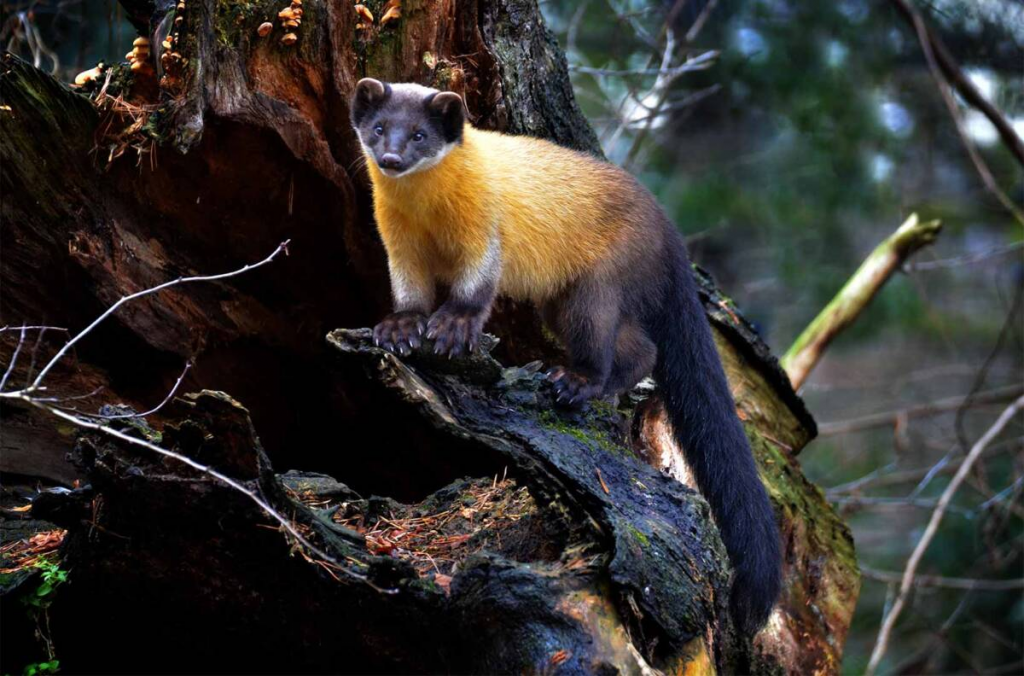
- It is found across the Himalayas, South Asia, Southeast Asia, China, Korea, and parts of Russia.
- In India, the yellow-throated marten is found across the Himalayan region and in other parts of the northeastern region, including Assam.
- IUCN Status: Least Concern.
- It is protected as a Schedule II animal under India’s Wildlife Protection Act.
About Kaziranga National Park
- It is located in the northeastern state of Assam.
- It was established in 1908 as a reserve forest and became a national park in 1974.
- It was declared a UNESCO world heritage site in 1985.
- It is the largest habitat of theIndian rhinoceros (Rhinoceros unicornis).
Source: TH
Padma Barrage
Syllabus: GS1/Geography
Context
- Bangladesh has approved a large river engineering project called the Padma barrage, on the Padma river, which is Bangladesh’s stretch of the Ganga, in Rajbari district.
About
- It is Bangladesh’s attempt to partially re-engineer the hydrology of its southwest region, which has become prone to drought after decades of reduced seasonal flows.
- The barrage will be 2.1-km-long and have 78 spillway gates, undersluices, navigation locks, fish passages, and associated embankments.
- According to Bangladesh, the project will affect roughly 37% of the country’s land area and irrigate around 2.88 million ha of farmland.
About Padma River
- The Padma River is one of the largest and most important rivers in Bangladesh.
- It is the main distributary of the Ganges River after the Ganges enters Bangladesh from India.
- The Padma flows southeast, joins the Jamuna River (the lower Brahmaputra), and later merges with the Meghna River before emptying into the Bay of Bengal.
- It is a major part of the world’s largest delta system, the Ganges–Brahmaputra–Meghna Delta.
Source: TH
Previous article
The Middle Class Journey: Progress Powered by Policy
